


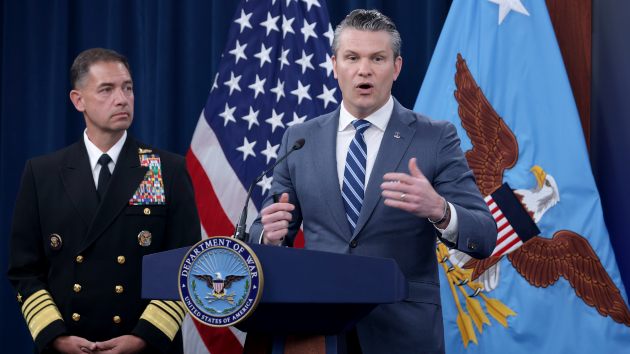
(WASHINGTON) — Defense Secretary Pete Hegseth announced on Tuesday that the annual flu vaccine will now be optional for all U.S. military personnel, both active and reserve.
Previously, the flu vaccine had been mandatory. The new policy is in line with a previous change of making the COVID-19 vaccine optional.
Hegseth announced the change in a video posted on social media.
“The notion that a flu vaccine must be mandatory for every service member, everywhere, in every circumstance, at all times, is just overly broad and not rational,” Hegseth said.
“Our new policy is simple: If you, an American warrior entrusted to defend this nation, believe that the flu vaccine is in your best interest, then you are free to take it; you should. But we will not force you,” Hegseth added.
Referring to the COVID-19 vaccine that led to the dismissal of 8,000 service members who refused to take it, Hegseth said, “Our men and women in uniform were forced to choose between their conscience and their country, even when those decisions posed no threat to our military readiness.”
“That era of betrayal is over,” Hegseth continued.
The flu vaccine has been required for the military since 1945, at the end of World War II, partly tied to the threat of biological warfare use by rival nations and as well as the devastation that the flu pandemic of 1918 wreaked on U.S. troops, according to a 2022 analysis from Wright State University in Ohio and the U.S. Air Force.
It’s estimated that between 20% and 40% of Army and Navy personnel fell ill, with more than 26,000 deaths among U.S. soldiers.
After researchers noticed the effectiveness of the vaccine fading, the mandate was withdrawn in 1949. This was later found to be caused by abrupt and major changes to the flu virus — and the mandate was reinstated in the early 1950s after the changes became “clearer and combatable,” according to the analysis.
Compliance among military health care personnel has exceeded 95% in past years, compared to less than 75% among civilian health care personnel.
Hegseth said soldiers can take the vaccine if they so choose, calling it an attempt to “restore freedom and strength to our joint force.”
While the move is framed as expanding personal choice, health experts warn it could quietly erode military readiness.
“As a military veteran and nurse practitioner, I believe Defense Secretary Pete Hegseth’s decision to end the annual flu-vaccine requirement for U.S. troops is a serious lapse in judgment,” Dr. Richard Riccardi, a professor and executive director of the Center for Health Policy and Media Engagement at The George Washington University, said in a statement.
Riccardi, who served on active duty in the U.S. Army for 31 years, said not making the flu vaccine will lead to more illnesses and, as a result, more missed duty days and more hospitalizations.
“In the military, vaccination is not political theater. It is force protection. Troops live and work in close quarters, where influenza can spread quickly and sideline otherwise healthy service members, said Riccardi. “The CDC continues to recommend annual flu vaccination for everyone 6 months and older because it remains the best way to reduce the risk of flu and serious complications.
So far during the 2025-26 season, the Centers for Disease Control and Prevention estimates there have been at least 31 million illnesses, 380,000 hospitalizations and 23,000 deaths from flu.
Of those deaths, 143 have been among children, 85% of whom were not fully vaccinated against influenza, according to the CDC.
Copyright © 2026, ABC Audio. All rights reserved.