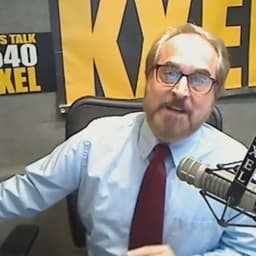
And as KXEL Live and Local continues on this Tuesday, that's when you're hearing the conversation.
We recorded it yesterday afternoon for the convenience of schedules, and I'm joined on the news line by the Governor-Elect of the State of Iowa, the Honorable Rob Sand.
Governor-Elect Sand, congratulations, and thanks for taking the time.
Well, thanks for having me, Jeff.
Appreciate it.
You are the, you and your running mate, the single largest vote-getter.
of all the statewide races, more than three quarters of a million Iowans cast their ballot for your team a week ago.
Give us a sense of the message you received, what you think they were telling not only you as the candidate, but everybody involved with state government.
Sure.
Well, number one, you know, I want to say thanks to the folks that supported us.
And to the folks that didn't, I want to say, look, I'm going to work for you just the same.
I hope if you see me out and about in Iowa, you stop me and, you know, respectfully, you know, tell me why I didn't turn your vote.
I'm always ears to hear from people.
But, you know, the scale of this thing is actually pretty incredible, Jeff.
We just received the largest number of votes of any candidate for governor since World War II.
with a single exception, and that was in the 1964 wipeout.
Harold Hughes got more votes that year than we just did, but nobody else ever has.
So it's a pretty strong mandate for our message.
Now, our message is common sense, getting stuff done that actually works for islands and gets us back to common sense territory.
And I've been encouraged, it sounds like in my conversations,
with legislators on the other side of the aisle that they are picking up that message as well.
And I want to see us.
Pick it up and run with it and get a lot of good things done when the legislature comes to town and when I actually take office in January.
You have been kind enough to join us in your role as state auditor every month here on the radio.
A number of state officials do the same thing and the invitation is there for you as governor to join us on the radio on a monthly basis as your schedule and as news permits.
Happy to do it.
As you look at the whole framework,
We've talked and we talked in the TV studio about what you might do day one.
Well, that day one list is quite, quite long.
But give me a sense of what is appealing to you within the first couple of weeks.
What are the things that you as governor can do right away to have an impact?
Well, right away, of course, means things where I'm doing it independent of the legislature, which takes time.
So that means two things, beginning the process of ending.
the privatization of any Medicaid in Iowa, which has driven up costs for ordinary Iowans and made the quality of care worse.
It also means an executive order to do what we did in the auditor's office, where we said, you know, there's no reason that our employees should have to live in Des Moines.
If they want to live somewhere else in Iowa, well, this job can be done from anywhere in Iowa.
We're going to let them.
And I want to do that for other state jobs as well because
The presence of one more family in a small town makes a much bigger difference for that town than it does in the Des Moines metro area.
So we shouldn't be having taxpayers from across the state subsidize the prosperity of the most prosperous part of the state.
If people want to have a state job that can be done from anywhere and live elsewhere in Iowa, then we should let them do that.
Longer term, look, again, my priority is exactly what I said it was during the campaign.
I want us to get back to
Putting structures in place to make government be good, not left versus right, but right versus wrong.
We should have term limits.
We should have age limits.
Independent voters should have an equal right to participate in our democracy.
We shouldn't be forced to pick between the lesser of two evils, one from each private club.
We should have mandatory public town halls.
All this stuff
would mean that no matter what the problems is that we're facing, we'll have people in office that are actually focused on solving our problems because it'll be harder for them to do anything else.
And then, of course, we got to get to work on cleaning up our water, getting our cancer rates down.
We need to fund IWILL.
That's a place of bipartisan agreement between me and my opponent.
And so I think there's a lot of good stuff that we can get to work on here.
Rob Sand is the governor-elect of the state of Iowa.
He joins us on KXEL a week after the historic 2026 election.
With regard to economic development and business, there is a role to be played by government.
There's a role to be played obviously by the private sector.
Give me your sense of the partnerships that can exist and how they might be different under your administration than may have been the case in the past.
Well, we saw in recent years, two of the biggest economic development deals in Iowa history go for data centers.
I don't think we should be doing tax breaks for data centers.
In fact, I want to see a bill in my desk that really makes it so that they are paying their way.
They need to be paying full freight.
If anything is getting built in Iowa, it needs to be a winner for Iowans who already live here.
And if it's not, then they can go build somewhere else.
Uh, some of this is about taking some pride in our state.
You know, we don't need to go, uh, throw the kitchen sink at people to come here.
This is a wonderful place and, uh, any company would do well to locate here.
And so, uh, while we're willing to have conversations, uh, about, uh, what that looks like, at the end of the day, we should, we should make sure that, uh, we are recognizing our own value and what we're bringing to the table.
So, when it comes to data centers, we're not doing deals for those.
They're going to pay all their taxes and then some.
We're going to, and we've got a detailed plan for this at RobSan.com that we laid out during the campaign and I'm sticking with that plan.
And if it's other issues, you know, you take them as they come.
But I want to see us mostly be focused on improving the lives of Iowans that are already here and helping the state grow.
I know you have been asked this question already, but I'll still ask.
Your thoughts on the proposed steel plant for southeast Iowa.
There was a special session of the legislature bills and laws were amended to accommodate this.
Is that the kind of deal that you personally, if you've had time to study it, that is, personally think is a good idea?
Is that a model for the future or what?
Well, look, any deal, this one included, we need to make sure that the company that's coming here is actually getting things done.
before they get any assistance from the state of Iowa.
It needs to be that they have actually done something and made progress, that they've built what they're going to build, and then that support can come from the state after they reach certain benchmarks.
This company has operations in Minnesota.
Minnesota gave them a lot of upfront support.
That didn't work out so good.
And so what we need to be doing is making sure that they're actually investing and putting their money into things.
And once they've done it, you know, the state can have its role, but we don't want to do that at a time because we don't want to get taken advantage of.
The kinds of safeguards that are necessary.
Obviously, the pushback is going to be, well, this state's doing this, that state's doing that.
We have to be competitive.
What you're suggesting is, in essence,
I don't really care what anybody else does.
We have to have pride in ourselves.
I wouldn't go so far as to say we don't care.
Like I did say, we want to have conversations.
We want to be reasonable.
But some of the deals that got done for data centers in this state were just way too generous.
And there's a certain point where everybody knows this.
Every Iowan knows this.
Well, if it's even true when you're buying a car, which, you know, I get my trucks used, but whether or not you're buying them new or used, it's a little bit different when they're used because there's not a sticker price on it.
But you got to know when you're ready to walk away.
You got to know what something's worth.
And that doesn't mean that we're not... What that means to me is that at the end of the day, we should be on the lookout for good opportunities.
We should engage in fair deals.
But that we shouldn't be throwing Iowans' hard-earned tax dollars at something just because we're excited about getting a headline out of it, or because we're excited about the name of the company that's coming with it.
We need to know our own worth and our own value, and if they're asking too much, then we should be saying, well, sorry, we're not going to do that, but we bet even though we're not going to do that, we bet you're going to build here anyway, because we've got a pretty good offer for you and a pretty good state.
One of my pet peeves is expansion at the expense of good Iowa farm ground, the best farm ground in the world.
It is easy to expand from a city into the rural areas to build whatever it is, not data centers necessarily, but whatever urban sprawl looks like.
That bothers me, but at the same time, I don't want the government telling a landowner what they can and can't do in terms of selling property.
We have a lot of areas that could be revitalized within our cities.
I'm just wondering your sense of a plan for the state because I think we're now to the tipping point where if we're talking about economic development, we may need to balance with agriculture and the quality of life that we've all come to love.
Yep, and in you you laid out the pros and cons there you don't want the government telling people what to do But at the same time we got this all this beautiful countryside and all this productive agricultural land too And so I think you're right I think this is one of those things where you want to when it's when it's workable when it's doable you want to see redevelopment in places that maybe are now an empty lot and you want to try to focus on building
in places that could use a little bit more attention so that we're not just always always expanding outward because at the end of the day that that's not good for traffic.
It's not good for getting around and it's not good for the countryside.
Final question for Governor-elect Rob Sand.
How has your life changed in the past week since the election?
And I say that because
You've planned for it, you ran.
But there's got to be some things that are just different other than people calling you Governor-Elex Sand.
Well, this is kind of important to me.
I did drive myself home in my own truck from the election night party.
You know, as I've gotten busier and more responsibilities, I've typically had a driver, but that's a little bit
That's going to be a little bit different in the future.
Certainly, there are more people reaching out now who, maybe they're looking for a new friend.
I've already got mine.
And it's the people I've known forever.
And so the level of communication certainly is complicated.
I had over 1,100 unread text messages at one point.
And some of that is just realizing that I'm
going to have to be a little bit more focused and triage some of that stuff a little bit better.
But I want to stay who I am and who I've always been.
I was able on Sunday afternoon to get out in a tree stand for three hours.
It's a beautiful time to be out.
And that's the kind of stuff that still at the end of the day is important to me.
I ran very much as myself.
And that's who I plan to be as governor.
And so I'm going to try to make sure I
Stay stay true to what I said and stay true to who I am
The governor-elect of the state of Iowa the honorable Rob sand Thank you for the extended conversation and I do look forward to continuing them on a regular basis once you take office in mid-January
You betcha.
Thanks Jeff
the governor-elect of the state of Iowa Democrat Rob sand one election one week ago today a conversation about
We recorded yesterday afternoon for convenience of schedule so you could hear it now on a Tuesday on News Talk 1540 KXEL, where Iowa comes to talk.
News Talk 1540 KXEL where Iowa comes to talk more than a dozen teenaged 4-Hers were in Greece earlier this year as part of the STEM Agriventure Program.
We're going to find out more about what they learned from Iowa State University Extension 4-H STEM Education Specialist Alexa Groff who's back with us on the program.
Thanks for being with us again.
Yes, thanks Tim for having me.
So this was an exciting development that took some time to put together.
Just give us the timeline of what the students experienced.
We can talk about some of the other details about how the project came to be, but what did this look like for those students who were on the other side of the world?
Yeah, so our students started back in the springtime and we started introducing each other.
We put the students into groups and they got a topic to research.
And throughout the summer, we met and they gave their presentations over their topic, preparing them to learn just a little bit more about agriculture, STEM, technology, food systems, things like that before we traveled over to Greece.
And then at the State Fair, we had all of the students come to the State Fair and do some outreach with fairgoers at our 4-H building.
And that was the first time they got to meet each other in person.
And then we took off across the country for 11 days.
And we stayed at the American Farm School, a partner in this...
adventure that we went on.
We stayed at the American Farm School in Thessaloniki, Greece, and they spent six days there.
And then we traveled around Greece and made our way to Athens.
And so we learned about different aspects as we traveled.
But the kids really got a firsthand experience in lives of students over there and farmers, along with what they're used to here in Iowa.
Let me go back even a step further, Alexa.
16 students participating in this from all over the state of Iowa.
My hunch is that there were probably way more than 16 students who wanted to make this trip, so how did you narrow it down to this particular group?
Yeah, so since this was our very first time doing this program we actually took everyone that had applied and so it was more of a let's see who would be interested and Honestly, I was shocked that we were able to get 16.
I was thinking maybe we would have nine ten awesome 16 ended up going so it
it really surprised me that we had as much interest as we did, and we're already getting interest for future trips.
So yeah, there wasn't much of an application process for this first time, but in the future there might have to be.
We'll see.
We're talking with Alexa Groff, Iowa State University Extension 4-H STEM Education Specialist about the recently returned group back from Greece who was on the STEM Agriventure program trip that went across to the other side of the Atlantic and learned quite a bit, it sounds like, about farming in Greece, about other aspects of Greek life and culture.
And one of the things that I know that you mentioned in a story about this
on the Iowa State Extension website is that this was not a vacation, this was not a tourism trip, this was intended to be a learning trip.
So give us an example of that.
Yeah, so for example, once we got to Athens, we actually visited a local honeybee farm.
And so they got to see how they produce their honey and kind of what makes it different from...
here in Iowa versus Greece.
They got to taste different kinds of honey.
And we actually had a couple kids on our trip that raise honeybees.
And so for them to see the difference, they were shocked.
They wanted to bring back some of the practices that they over in Greece are utilizing back to Iowa, back to their home farms.
We did some service learning as well at the American Farm School.
We planted some trees.
In fact,
The kids did such an awesome job that they thought it was going to take like half a day to plant these trees.
They ended up doing it like a lot faster, like 45 minutes.
It took them to plant these trees because we had so many hands, but we really utilized each and every opportunity that we had over there to learn.
So they learned about harvesting olives and how.
harvesting over here we use heavy machinery and equipment and over there how they're harvesting their large crops like olives they're hand picking so they're not using the heavy machinery they they take their time they're picking by hand they were learning
every second of the day.
I think we would get up about 7 a.m.
have breakfast and then we were on the go until it was dark and every opportunity we had we were learning about something different.
You know hearing you talk about the students who were interested in honey production for example makes me wonder
How much of the activity was tailored to the students and how much of it was fortunate coincidence that you happen to have people with that interest and were able to make that stop?
Yeah, what was really cool is I had spent about
It's been ultimately about two and a half years planning this program.
I think planning the activities, it's been closer to a year and a half.
But pure coincidence about like the lineup with having students who have honeybee farms at home, things like that, pure coincidence.
I had done a site visit over there to make sure what we would be doing would make sense and the trip would make sense.
And it was beyond
what I could have imagined.
I have traveled with a few of these students before on other things that I do and the ones that I had traveled with looked at me during the end of the trip and they're like, this was the best trip I've been on.
The group was awesome.
So for 11 days, 16 high school students, they just meshed so well.
And what's really exciting is
The trip was awesome, right?
It was a learning experience.
They were learning the whole time.
They actually have to put lessons together in their group.
So we're getting about 25 total lessons that these high school kids are writing.
And then what's going to happen is eventually they'll be published and they're going to create a Greek day camp in hopes that we can launch that this summer.
They're actually going to teach younger students.
one of their lessons.
So that's part of the teens as teachers model that we are following.
We're really excited to give those kids that leadership opportunity to get some younger students excited about maybe what their future looks like.
Talking with Alexa Groff, Iowa State University Extension 4-H STEM education specialist about the recently returned group from the STEM agriventure trip to Greece that happened just within the last few months and these students are going to have the chance to apply for some college credit from this trip.
Yeah, so they are enrolled as high school kids in the very first college credits that Iowa State University and Iowa 4-H are working together with.
It has been a long time coming and we hope that this opportunity kind of opens more doors for 4-H programs to be offered to be able to get more college credit from Iowa State.
So, Alexa, why Greece as opposed to many different countries that
probably could have been picked, and would this be a situation where if this program is going to have another life, another incarnation, would it be Greece again?
Would there be another destination you'd want to take students to?
Tell us a little bit about those decisions.
Yeah, so great, great question.
The former Cal's Dean, Dr. Dan Robison, had caught wind of me traveling with students in another program that I do called STEM in Motion.
And he had reached out and asked if I would be interested in potentially creating a program.
So Iowa State University sends
undergraduates to the American Farm School, and they have a big partnership now where you can get your degree through Iowa State, and that relationship has been many, many, many years.
And so Dr. Robeson at the time was like, hey, Alexa, would you be interested in this?
And I was like, absolutely, this sounds amazing.
So I took that, it's called a familiarization trip.
I went over, I checked out the site, I got to do some things, and then I created this program.
And so my hope is, yes, we continue this.
I think Greece is absolutely an option.
I have a dear colleague in Ohio.
He actually was the first 4-H group to send kids over there.
So Steve Brady is my friend from Ohio State and we've actually
kind of linked up into kind of talking to each other.
He helped me out and he is searching for other places and I think that you know in the future there might be some different locations.
As for now I think our next one will be in Greece but the possibilities are endless and it's exciting to see kids get really excited about agriculture and STEM and
What was really cool about the trip was that they had to put together journals.
So they had to journal every day and then that's part of their grade.
And so as I was reading through some of those journals after we got home, their realization about just life in general is beyond 16, 17, 18 year olds.
One student was like, this just solidified it for me.
Like, I want to make a difference.
I want to go into international law.
This is what I want to do and this 4-H trip changed my life.
And so for that, that for me is enough.
And it makes me really happy that these kids are finding things outside the norm of what 4-H is.
So, Alexa, I know this was a heavy lift.
You said this was a couple of years in the making to get this group over to Greece and back with all the programming and planning that had to be done ahead of time.
For someone who's listening to this this morning thinking about their kids, their grandkids, maybe someone in that 4-H age group themselves who's thinking, that sounds pretty cool.
What would you tell them?
What's the forecast for when this opportunity might come back around again?
Yeah, so we're hoping to launch another session of STEM Agriventure this next year.
Look for something after the beginning of the year.
The trip is during October and that is because in order to go over to the American Farm School, we do interactions with the
Greek students, the Greek high school students at the American Farm School.
And so they have to be in session.
And so they start school at the end of September.
And so that gives us the opportunity to have that interaction.
But I think my advice to students, to parents out there is be open to opportunities.
be open to meeting new people and getting outside of your comfort zone.
I think that has led me and the students that I have traveled with, too many, many, many opportunities that they never thought even were possible.
They never expected it and it can just lead to connections down the road and a lifetime of memories.
Alexa Groff is Iowa State University Extension 4-H STEM Education Specialist and just back from the STEM AgriVenture trip to Greece in the last few weeks with 16 Iowa 4-H students.
Thanks so much for being with us, Alexa, to tell us about the trip.
Thank you so much, Tim.
I appreciate
it.
This is the station where Iowa comes to talk.
News Talk 1540 KXCL.
Pleased to welcome on the news line Elliot Gajadhar.
Mr. Gajadhar is Head of Accounting Strategy and AI for 1-800-ACCOUNTANT.
They are online at 1-800-ACCOUNTANT.COM.
Mr. Gajadhar, thank you so much for taking the time.
Sir, good morning.
Good morning.
Thank you for having me.
Tell us about 1-800-ACCOUNT.COM.
Who are you folks and what do you do?
Sure.
So we've served, since our foundation, over a million taxpayers.
We primarily focus on small business owners.
So to provide tax strategy, tax filing, and advice for small business owners primarily across the U.S.
In 2017, Congress passed and the president signed the Tax Cuts and Jobs Act.
And it had a sunset clause.
It was for a limited duration.
For the life of me, I can't figure out why they do that sort of thing.
It is not helpful to businesses or individuals in planning to always have tax policy up in the air.
All right, so then you get to the summer of 2025 with the working class.
tax cut bill often called the big beautiful bill there were all manner of things woven into that including making the twenty seventeen provisions permanent i think i have the chronology correct all right so if that is the case now you're going to have democrats in the majority in both houses of congress starting next year are those changes that were just done a year year and a half ago are those in jeopardy in your eyes
No, not in particular.
So to give you a heads up on this, there are some changes in which we'll get sunsetted and some changes that already got sunsetted already for the most part.
But this happens throughout.
This is something new.
This happens throughout legislation, correlation just in general.
So in this case, it's always a bargaining power.
That's why it'll expire at certain particular times.
Interestingly enough, right now, with a Democrat
control congress or seem to be for the most part, uh, we're going to see some of those legislations.
I'll get reinstated and some will actually sunset and expire.
I will not renew.
All right.
So that is absent anything else.
Democrats ran supposedly.
I say supposedly because some of the bills that have been proposed post-election had nothing to do with this topic, but I heard during the election it was about affordability.
It was about fixing things in the tax system to make things more fair, etc., etc.
What do you see on the horizon of what may take place with a change in the Congress?
So there's three areas in which both the Democrat and Republican side are focused on.
and the same areas which talk topics right now.
We're going to focus on family health care, in this case, tax credits for health insurance, and then other items regarding tax and overall for wealthy individuals and so forth.
But that's what I'm looking at.
I'll look at it as also housing.
So really, it'll be health insurance taxes, taxes on families, and then housing primarily.
Well, let's talk about higher taxes on wealthy individuals and corporations now when I did interviews with candidates Typically those who were the challengers in this case from the left would say We need to make the rich pay their fair share and I would ask well What do you mean by rich and then I would ask what do you mean by fair share?
I must say I did not get very many specifics in either of those
in response to those questions.
So has anybody started talking numbers?
Because it's one thing to say you're going to tax wealthy Americans until you start defining what wealthy means.
Correct.
So there's very, very levels for this.
If I look at book is proposed legislation, the thresholds are very low.
He wants to increase standard reductions quite considerably.
So good chunk of Americans wouldn't pay
income taxes.
There will be disqualified from standard reductions.
When I say high in-network individuals and so forth, there's no set number.
There's no set number to say this is the threshold for income levels.
It depends on who's actually proposing their legislation itself.
Which therefore makes it very difficult, right?
Because it's one thing from a slogan standpoint to say
fair share or rich or whatever As the saying goes that the devil is always in the details trying to figure out exactly who means What and we just have not seen enough information to know is that a fair statement?
Yes, and there's also conflicting Proposals so the may seem too much information sometimes because there's no definitive standard and so now there is now by track a couple dozen
Proposals are floating around, but really there's no universal standard for
it the 2017 bill law and its successor It did greatly increase the standard deduction for individual income tax filers with the goal as I recall being to simplify the process in other words the fewer people who had to itemize deductions on taxes
Well, the simple of the process is for taxpayers.
And so now you're talking about a new proposal that would elevate that standard deduction even higher.
You're therefore gonna have very few people who fall into the itemized category.
And presumably the suggestion is those would be the ones who have more income, more deductions, more complicated situations.
Is that a good thing to streamline the process in the way that's being suggested?
It's a gray area.
So to give you an idea, sure, they may increase the standard reduction, but for example, a pass recently was changes to itemize reduction when it comes to being a local taxes.
So people who may not take a standard or who would typically take a standard reduction because the threshold tire would may itemize now, especially in high income states.
New York, for example, California and so forth.
So it's not a one size at all.
And that does bring us to the issue of deducting state taxes.
I mean, for a period of time in my state of Iowa on our state taxes, you could deduct what you paid in federal taxes.
They reformed things here, lowered the rates down to a flat tax and took away that federal deductibility.
So truly, this is a matter of where you live makes a huge difference because of
what you can and cannot deduct at that state versus local level, correct?
That's absolutely correct.
We're speaking with Elliot Gajadhar.
Mr. Gajadhar is with 1-800-ACCOUNTANT.
They are online at 1-800-ACCOUNTANT.com.
He joins us live on the news line on News Talk 1540 KXEL.
The executive branch of government
is controlled by Republicans with a president of the Republican Party in charge.
You're now going to have after the first of the year Democrats with the majority in Congress, that means that they will hold the chairmanship of committees.
And when you look at something like the Senate Finance Committee, that has oversight of the Internal Revenue Service.
So you're going to have different parties in essence, potentially dueling it out where you'd have Congress
looking at what the IRS is doing, they're not on the same side of the political spectrum.
Is that going to lead to anything substantive or is it potentially just a lot of fury and noise perhaps to score later political points without much impact on the everyday citizen?
I think it's a little bit of bulk.
I don't expect any massive sweeping generalizations or sweeping
legislation to pass.
Typically it won't because, as you mentioned before, Trump still holds veto.
So in this case, what I would see mainly is compromises or deals being made for the most part.
In this case, I'll give you an example.
If I'm looking for, let's say, the Democrats want to push a increase to daycare credits, as well as a child tax care credit.
In this case, in order to get it over the fence,
If I'm on the topic of family, for example, it may be a bargaining to say there's a permanent or there's a no tax on tips and overtime and seniors in which that is set to sunset in 2028.
It may be a case that's a bargaining chip in which both parties get together and say, hey, I want to compromise on this portion for daycare and on the same side, you want to compromise something on tips and overtime, for example.
So who I see it as
There won't be any gigantic legislative changes that's going to happen, no sweeping changes in particular, but there are different areas in which they could work together and come to some level of agreements.
And realistically, even if there had not been a change in the control of Congress, the answer you just gave still would apply.
Except the roles would be reversed if the Republicans wanted to get that no tax on seniors Extended then the Democrats would say well, then we want the child care credit.
I mean, it's it's the same conversation in other words It's just different people who in essence are leading it because of their position as a committee chair or a majority leader
Yeah, so the way I could propose or I could say this is it doesn't change what gets passed it changes who proposes the agenda first that's why I look at it as it doesn't
say there's going to be massive changes that come ahead, but it will control, you know, what narrative gets said first.
Now, I noted when I introduced you that you are the head of accounting strategy and AI for 1-800-accountant.com.
There's an awful lot of talk about AI.
There's an awful lot of talk I've heard from some Democrats either newly elected or newly emboldened as they'll be in the majority to talk about artificial intelligence, to put some limits on things, et cetera.
Impossible to use a crystal ball and accurately figure out what might happen, but what are some of the things that somebody listening to our conversation, what are some of the things that they should be listening for or watching
on that topic of a i going forward
all month in different on the subject but what i would be very concerned on is state legislations uh... for a i that's the story on a federal side as you mentioned before maybe from issues uh... getting stuff passed through on the state side i would like to turn is what i think that is what we thought of now and i already increasing it i mean different it doesn't matter that comes up from time to time
More often I'm not today but in this case my concern really be Do we throttle too quickly or do we put harnesses on things too quickly from both parts?
It would appear to me and and please tell me if I'm off base it would appear to me that with something of this scope Having individual state regulations.
That's potentially quite troublesome because of enforcement and the broad
Impediment that they would have in other words an outsized role in the process if one state throws up a roadblock and it might alter the broad trajectory That is to me much more of a problem 50 state legislatures as you suggested as opposed to one Congress Yes, I fully agree with that This is fascinating stuff, but the bottom line is I think what I hear you say is
There's nothing to panic about.
Democrats are going to take control of Congress, but that does not mean because of the split in government, that does not mean we're going to have wholesale changes to the tax system.
Yeah, that's what I
believe.
Mr. Gujantar, thank you so much for taking the time to walk us through this.
I appreciate it greatly.
Take good care.
Thank you, too.
And as KXEL Live and Local continues on a Tuesday morning, time for today's RFD 1540 conversation.
For that, we draw upon the insight of Dustin Hoffman, supervising editor, senior farm broadcaster Iowa Agribusiness Radio Network.
You hear their reports nine times each weekday here on the blowtorch.
And Dustin joins us for this extended conversation Tuesdays and Thursdays.
All right, members of Congress.
the lame duck session back in washington they could either clean up a lot of things or just get in each other's way as they're packing to go home for christmas some of them going home for good what's the chance of a farm bill we hear a lot of different things
well jeff the problem is we have the senate ad committee barely passing one but
We still have a Senate that needs to act on it.
The House is just waiting, and they could still have a conference committee.
Now, anything is possible.
I know we discussed last week that I found it highly doubtful that they would get anything done, because what incentive is there for the Democrats to give in to what the Republicans have on their version of the Farm Bill before they take control of the Congress?
And so that's going to be interesting.
But Senate Ag Committee Chairman John Bozeman says he's still having conversations with
what they call the Four Corners, which would be himself, Senate Ag Committee Ranking Member Amy Klobuchar of Minnesota, who will be leaving the committee to assume the governorship of that state coming up in January as well.
And of course, the House members there as well are waiting and trying to get something negotiated because once the Senate, if the Senate passes it, and you can talk about John Thune and what he has accomplished or not accomplished in a whole another time, but the fact of the matter is they're hopefully, they don't want to lose the Farm Bill, they don't want to get it not, they don't want to get
done.
I think they're also sick and tired of the fact that they are
gonna have to kick the can down the road again.
I don't think anybody wants to do that.
Klobuchar probably does not want to leave a legacy just like Stabenow did with no farm bill before she leaves the Senate.
And of course, there is those things with SNAP and some of the reprieves they've given to the states.
There also might be a bigger problem and may become something that doesn't get addressed if the Democrats take control.
So there is that belief as well.
And so there's really
they're trying to get it done.
You're also losing every member of the House Ag Committee from Iowa coming up here at the end of this term of Congress.
And so there's really some push to maybe get this done.
Obviously people either leaving because they've gotten new offices or because they've been voted out.
They don't want their legacy to believe we've been here and we never got the farm bill done.
And so because we haven't gotten one done since 2018.
So a lot of those outgoing representatives for the state of Iowa
never were there when 2018's Farm Bill was done.
And so that's a lot to kind of stick in the crawl there as well.
And so I think there's a lot of incentive to get this done, but there are still some sticking points.
That's an interesting point when you mention current Senator, Governor-elect Klobuchar of Minnesota, going home to take the new job without having finished the old one, that's not a good thing.
And to your point about the Iowa house delegation,
You've got folks who might still have political aspirations despite losing last week, and you sure don't want to start those off with the failure to deliver on the most important issue facing Iowa's economy, namely the stability of a farm bill.
Yeah, exactly it.
And so there's a lot of discussions that have to be had.
Of course, as we said, there's still some delays that still have to happen.
The Supplement and Nutrition Assistance Program or SNAP, those cost-sharing requirements for the states.
Of course, the Democrats on the Senate wanted a two or three year reprieve and additional to the 2029 deadline.
The Republicans were willing to give one more year to 2030 and said this has got to be done.
And so like they said, they still know, they say
there's still no excuse for having a 20% error rate and not trying to get it down to zero and not trying to give any incentive to get it down to zero.
They're even trying to, we can get it down to 6%, that would be a good move.
But they said there's that argument that has to be had and what incentive do the Democrats have to yield on that if they're going to be taking control of the House and the Senate.
However, not enough to swing it their way either, as the Democrats are well aware, it doesn't take a majority.
Just because you have a majority doesn't mean you're going to have enough to sway it one way or the other.
And so the senators understand that.
So they still have to look at, they're going to have a long uphill battle.
well to do anything they want to do.
They know it could just be as just a stubborn.
Do you start with a little good faith and say, okay, we're willing to give in on this part of it with the farm bill.
Maybe that way you guys will meet us halfway on some of the things we're going to want to do when we take control of the Congress and maybe a good faith.
Maybe we actually see some stuff get done.
It is amazing that it's taken how many years and how many lame duck sessions, Jeff, to and now a truly lame duck session to maybe finally get the ball moving on some of these things.
US Congresswoman elect Lindsey James Democrat from Northeast Iowa second district was on the program last week after the election and specifically called out her party for not passing the farm bill.
I wonder how many other folks who have just been elected are going to look at some of the failures.
and say, okay, it was one thing for our party.
I'm speaking if they were Democrats to be the party of no.
Well, now we've got it.
And so we've got to get things across the finish line.
And so at the same time, you've got some of these folks who don't want to leave town with the current Congress having not accomplished this.
You may have a whole bunch of other folks who say, well, you didn't do it to this point.
No sense hurrying.
will take the reins come January 2nd or 3rd whenever this wearing in takes place and so that might be yet a different impediment as opposed to the ones that we've had all along and yet who suffers through the whole thing the people who actually need the assistance and I'm talking not only on the farm but I'm talking about those food consumers who need the government support.
Exactly it.
The one thing that I have said though, and we talked about this last week, Jeff, is if the Democrats rode definitely a wave of the fact that things have not gotten better in two years.
In fact, they've gotten worse in some aspects.
Now, I may have some adamant administration supporters that are going to argue with me tooth and nail about this.
But for the average person paying their bills and getting food and everything else and the gas prices, you can argue that they are
not great.
And things have not changed and in fact gotten worse.
And so you look at some of the situation and say, if the Democrats want to win this election, truly win this election, now they got more votes and they got more seats.
If they're going to truly win this election, they're going to have to govern a whole people again.
Not the run through your set of propaganda like anybody else has done in the past.
We've seen
Both parties control Congress at different points in the last two and a half decades.
And, you know, the rhetoric has been what's been causing the problems.
If they are truly going to win this election, they are going to have to get the Republicans on board.
We've seen some of that, as you said, folks calling out their own party for saying, hey, you guys, you know, maybe we don't agree with what the Republicans are doing, but we didn't offer anything other than a no.
And you also have Democrats over here in the third district saying that, hey, if we get rid of the Secretary of Defense, Pete Hegseth,
Senator Ernst the Republican outgoing senator would be a perfect fit for that job And why not have an Iowan with military experience in that job?
So you're seeing Iowans on the on the left Just kind of sticking their neck out a little bit against their party showing a little bit of okay This is not what we are supposed to be about.
We need to make changes The the no has to stop somewhere.
Maybe that is what they need to do.
I mean, maybe that's what they're gonna do I don't know what their plan is but if they truly want to win more than the votes and more than the seats and actually
when the American people over to what they're thinking about doing, they're gonna have to get so far away from that far left, get back in the middle, and the Republicans needed to do this too, but it didn't happen enough, and that's why we're in this situation we're in with a new Congress, again, and a new power changing.
You need to get back to the middle of the road because we have the far left and the far right screaming louder than anybody else in the middle.
and they are not giving in to each other at all and you have a good majority of people who are moderate or even closer to the middle road even if they never vote for that other party they're closer to that middle road of we got to work together to get something done and quite frankly we saw
I saw and we talked with several Republicans who said they want Democrat, not because they were voting in what the Democrats espouse, but because they were wanting to send a message to the administration that they're sick and tired of the screaming and the shouting and the doing whatever you want to do.
You need to just get together and work.
The people are suffering while all you do is sit and yell about it.
To be continued, if only they in Washington would listen to you and I. Common sense would prevail, would it not?
But George Carlin made the great insight that if common sense were suddenly introduced into the political system, the thing would collapse.
Certainly wouldn't know what to do with it if they had it.
Dustin, thank you kindly.
We know what to do with this conversation.
We'll do it again Thursday.
Sounds good, Jeff.
Dustin Hoffman, Supervising Editor, Senior Farm Broadcaster Iowa Agribusiness Radio Network, and he joined us for this Tuesday, RFD 1540 Conversation on News Talk 1540 KXEL, where Iowa comes to talk.