


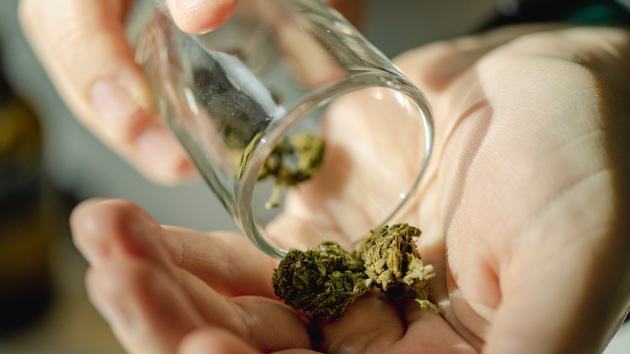
(WASHINGTON) — Acting Attorney General Todd Blanche signed an order on Thursday reclassifying state-licensed medical marijuana as a less dangerous drug.
The order moves marijuana from Schedule I to Schedule III, putting state-licensed medical marijuana in the same category as some pain medications, ketamine and testosterone.
Schedule I drugs are defined as “drugs with no currently accepted medical use and a high potential for abuse” while Schedule III drugs are defined as “drugs with a moderate to low potential for physical and psychological dependence,” according to the Drug Enforcement Agency (DEA).
While this change aligns federal guidelines with many state laws, marijuana is still illegal at the federal level. It does not remove cannabis from the federal controlled substance list, legalize recreational use nationwide or allow unregulated sales similar to tobacco and alcohol.
However, the move could allow for expanded research and ease many of the tax and regulatory rules placed on the cannabis industry.
“These actions will enable more targeted, rigorous research into marijuana’s safety and efficacy, expanding patients’ access to treatments and empowering doctors to make better-informed healthcare decisions,” Blanche wrote in a statement on X.
President Donald Trump announced late last year that his administration would seek to reclassify marijuana, but not legalize it for medical or recreational use under federal statutes. Over the weekend, the president appeared to express frustration that the administration was slow-walking the effort.
Blanche said the Justice Department and DEA will begin the process of potentially reclassifying all marijuana to Schedule III. The DEA is planning to hold a hearing in late June.
“The new hearing … will provide a timely and legally compliant pathway to evaluate broader changes to marijuana’s status under federal law,” according to a press release from the Justice Department.
The process of reclassifying marijuana began under the administration of former President Joe Biden.
In October 2022, Biden asked then-Secretary of Health and Human Services (HHS) Xavier Becerra and then-Attorney General Merrick Garland “to initiate the administrative process to review expeditiously how marijuana is scheduled under federal law.”
The HHS in August 2023 made a recommendation to the DEA to move medical marijuana from Schedule I to Schedule III.
In May 2024, the Justice Department announced Garland had submitted a notice of proposed rule-making to move medical marijuana to Schedule III, with DEA announcing in August 2024 that a hearing would be held on the proposal.
That hearing was scheduled to begin on Jan. 21, 2025, but was postponed about a week before by a judge.
Marijuana is the most widely used federally illegal drug in the country. Nearly one in five Americans — 52.5 million people — reported using it at least once in 2021, according to the Centers for Disease Control and Prevention (CDC).
So far, 24 states and the District of Columbia have fully legalized recreational marijuana for adults, allowing adults aged 21 and older to possess, use and, in most cases, cultivate small amounts of cannabis, according to the National Conference of State Legislatures.
Although cannabis may have potential medical uses, it has also been associated with mental health problems, impaired driving, and lung and heart conditions. About three in 10 cannabis users will develop cannabis use disorder, meaning they are unable to stop using cannabis even though it’s causing health and social problems, according to the CDC.
Cannabis use directly affects the parts of the brain responsible for memory, learning, attention and decision-making, the CDC says.
The CDC also cautions that it can cause harm to brain development in young people and use during pregnancy may be linked to lower birth weight and possible developmental effects.
Copyright © 2026, ABC Audio. All rights reserved.