


(NEW YORK) — Iranian attacks on significant energy infrastructure and refineries in several Gulf countries pushed oil and gas prices higher in volatile trading on Thursday.
Brent crude oil prices, a benchmark for global trading, climbed about 2%, hitting nearly $110 a barrel for contracts to purchase oil in May. The price rose as high as $119 early Thursday but pared some of its gains by the afternoon.
The benchmark for European gas also surged by about 12% after Iran on Wednesday and Thursday mounted retaliatory strikes targeting energy sites in several Gulf countries.
An Iranian missile attack struck oil refineries on Thursday in Haifa, Israel, where “interception fragments were identified falling in two locations following the evening barrage,” Israel Fire and Rescue said in a statement. Fire brigades worked to extinguish a fire that broke out at the site, officials said. No injuries were reported.
An Iranian drone struck a Saudi Aramco refinery in Yanbu, on the Red Sea, on Thursday, according to the Saudi Ministry of Defense, which said the extent of the damage was being assessed. That refinery is a joint venture between Aramco and U.S.-based Exxon Mobil Corp.
Kuwait also on Thursday said its Mina Al-Ahmadi and Mina Abdullah refineries, which are run by the state-owned National Petroleum Company, had been struck by drones. There was a “limited” fire at the Mina Al-Ahmadi facility, according to the official Kuwait News Agency.
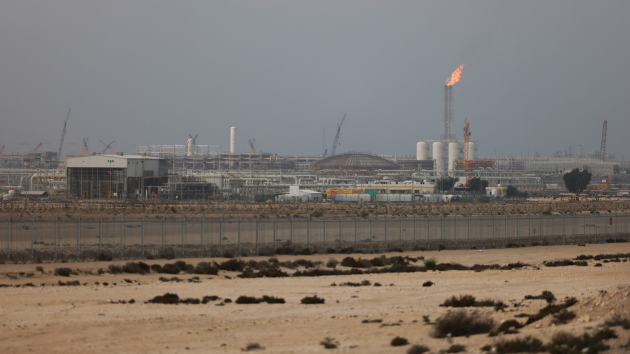
Qatari authorities said on Wednesday that Iranian ballistic missile attacks caused fires and “extensive damage” at the Ras Laffan terminal, which carries about one-fifth of the global supply of liquid natural gas. Qatar Energy, which runs the terminal, said on March 2 that it would bring liquefied natural gas production at Ras Laffan to a halt.
Iran’s Islamic Revolutionary Guard Corps had issued warnings for several Gulf energy production sites, including the refinery in Yanbu, after Wednesday’s Israeli strikes on the South Pars gas field, the largest in Iran.
Those attacks added uncertainty to a market already on edge, as the overall conflict and the near-closure of the vital Strait of Hormuz maritime passageway on the southern Iran coast, though which roughly 20% of the world’s oil supply is shipped, has sent key energy prices higher.
The Dutch Title Transfer Facility, which is widely seen as the European benchmark for natural gas prices, climbed about 15% in midmorning trading on Thursday. The benchmark rose as high as about 30% in morning trading, before shedding some of those gains.
Since the U.S.-Israeli attacks on Iran began on Feb. 28, the benchmark rate for European natural gas has roughly doubled. Brent crude had been trading near $70 a barrel prior to the conflict.
Copyright © 2026, ABC Audio. All rights reserved.