

(NEW YORK) — Stocks dipped in volatile trading on Thursday after President Donald Trump delivered a televised address vowing to hit Iran “extremely hard” over the coming weeks.
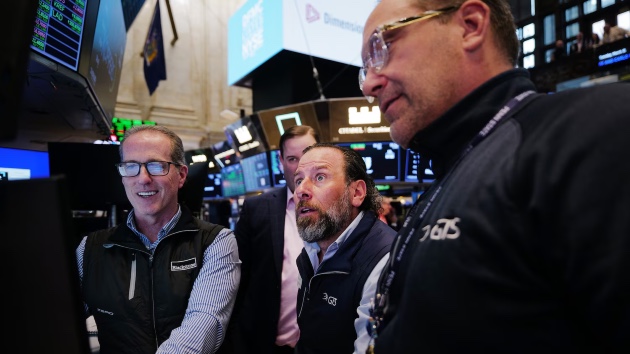
The Dow Jones Industrial Average fell 255 points, or 0.5%, after opening down by 600 points, while the S&P 500 dropped 0.3%. The tech-heavy Nasdaq declined 0.4%.
Each of the major indexes tumbled more than 1% in early trading, but they quickly recovered most of those losses.
The rollercoaster trading followed losses across Asian and European markets. Tokyo’s Nikkei 225 index slipped 2.3% and the pan-European STOXX 600 fell 0.6%.
Oil prices, meanwhile, surged as traders feared a persistent supply shortage amid the ongoing U.S.-Israeli war with Iran. U.S. oil prices climbed more than 10% on Thursday, registering about $111 a barrel.
Gasoline prices in the U.S. ticked up to $4.08 on average per gallon, marking a leap of $1.09 over the past month, AAA data showed.
Speaking at the White House on Wednesday, Trump voiced mixed messages about his plans for the Middle East conflict. He said Iran is no longer a threat to the U.S. and the war in Iran is “nearing completion.” However, he added, the U.S. plans to continue striking Iran over the next two or three weeks.
“We’re going to bring them back to the stone ages where they belong,” Trump said.
The trading volatility on Thursday interrupted an upswing for markets earlier in the week. On Tuesday, the Dow Jones Industrial Average soared more than 1,100 points, adding another 220 points on Wednesday as traders anticipated Trump may signal an off-ramp from the war in his evening remarks.
Since the war with Iran began on Feb. 28, Trump has issued conflicting signals about the expected duration of the war. On several occasions, stocks have climbed or fallen as markets weighed the implications of Trump’s comments.
The war prompted Iran’s effective closure of the Strait of Hormuz, a maritime trading route that facilitates the transport of about one-fifth of the global oil supply.
The vast majority of fuel delivered through the strait is bound for Asia, placing the heaviest pressure on energy supply in that continent. Since oil and gas are sold on a global market, however, the shortage has sent prices rising for just about everyone.
On Wednesday night, Trump urged other countries to take responsibility for reopening the strait.
“The countries of the world that do receive oil through the Hormuz Straight must take care of that passage,” Trump said. “We will be helpful, but they should take the lead in protecting the oil that they so desperately depend on.”
A potential U.S. exit from the war without ensuring that the strait is open could cast uncertainty over the path to a resumption of normal tanker traffic and a remedy for the current global oil shortage.
Copyright © 2026, ABC Audio. All rights reserved.