


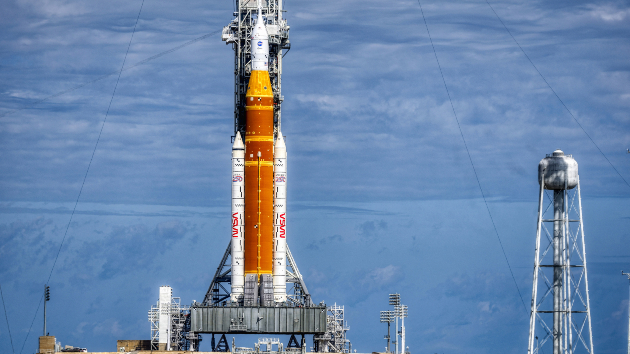
(MERRITT ISLAND, Fla.) — Weather conditions have again delayed operations leading to the launch of the Artemis II rocket mission to the moon.
The rollback of the Artemis II rocket and spacecraft at the Kennedy Space Center in Florida was originally scheduled for Tuesday afternoon. Due to high winds in the area, NASA said its plans to move the rocket and Orion spacecraft for Artemis II off the launch pad and back to the vehicle assembly building were pushed to Wednesday morning.
The 4-mile trek is expected to take 12 hours, the space agency said.
The move was deemed necessary after crews detected an interrupted flow of helium to the Artemis II rocket’s upper stage on Saturday. Helium did not flow properly during normal operations and reconfigurations that followed the wet dress rehearsal that concluded on Thursday.
The upper stage uses helium to maintain the proper environmental conditions for its engine and to pressurize liquid hydrogen and liquid oxygen propellant tanks, according to NASA. Essentially, helium is a critical element that ensures the proper flow of fuel into the rocket.
Once back in the vehicle assembly building, teams will install platforms to access the helium flow issue, NASA said. Teams will review potential causes of the issue as well as data from the 2022 Artemis I mission, in which teams had to troubleshoot helium-related pressurization of the upper stage before launch.
The Artemis II mission is a test flight that will send four astronauts on a more than 600,000-mile journey around the moon to test critical spacecraft systems, according to NASA. The crew will fly over the far side of the moon — passing between 4,000 and 6,000 miles above it — and spend a day observing and photographing the region.
After the lunar flyby, the astronauts will circle the moon for a return to Earth, in which the Earth-moon gravity field will help pull the spacecraft back to Earth over the course of its three-day return trip.
The Orion will then splashdown off the coast of San Diego after re-entering the Earth’s atmosphere, and the U.S. Navy will recover the astronauts from the Pacific Ocean.
The journey is expected to take 10 days total.
The mission sets the stage for the future Artemis III, which aims to someday land astronauts near the moon’s South Pole. The region has never been explored by humans before.
Artemis II will mark the first time humans have traveled beyond low Earth orbit since Apollo 17 in 1972.
In January, NASA delayed the Artemis moonshot due to near-freezing temperatures at the launch site.
Heaters were deployed to keep the Orion capsule on top of the rocket warm, while rocket-purging systems were adapted to the cold.
The rollback of Artemis II means it will not launch during the March launch window, NASA said.
The quick preparations will potentially preserve the April launch window, pending the outcome of data findings and repair efforts, according to the agency.
ABC News’ Briana Alvarado and Matthew Glasser contributed to this report.
Copyright © 2026, ABC Audio. All rights reserved.